Should I take a multi-mushroom blend or single-species products?
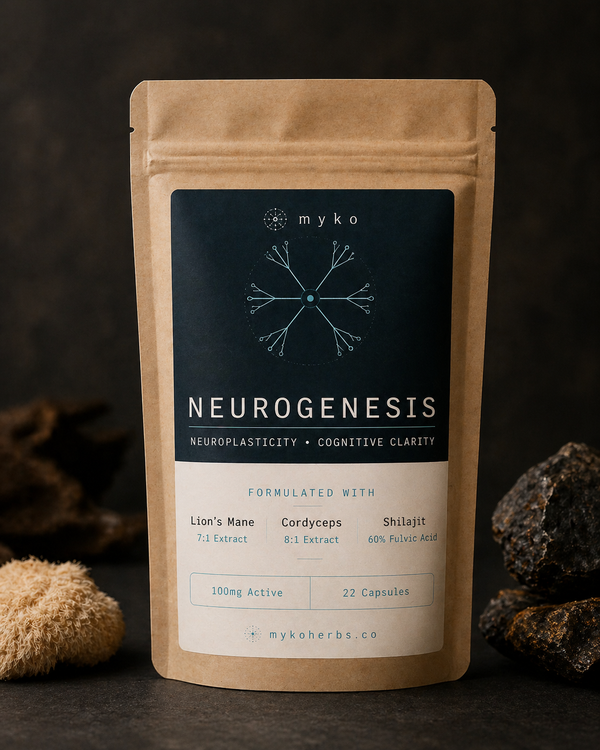
Depends on your goal. A multi-mushroom daily blend (like ADAPT) is well-matched to general daily-tonic use and immune-aware seasons. A single-species product is well-matched to specific pathway targeting (Lion's Mane for cognitive support, Cordyceps for energy metabolism). The MYKO active formulas (NEUROGENESIS, CORTEX, EMBODY, EUPHORIA) take a middle path — pathway-specific mushroom subsets plus the Active Botanical signal layer.
What if I'm vegan?
Almost all mushroom supplements are vegan (the mushrooms themselves are not animal products, and quality capsules use HPMC vegetable cellulose rather than gelatin). MYKO uses HPMC vegan capsules across the line. Check the "Other Ingredients" line on any label to confirm.
Are mushroom supplements legal?
Functional mushrooms (Reishi, Lion's Mane, Cordyceps, Chaga, Turkey Tail, Shilajit) are legal supplements in the US and most jurisdictions. The "Active Botanical" component in MYKO's protocol formulas is regulated differently in different jurisdictions; the front-label naming convention reflects that. Customers are responsible for understanding their local regulations.
A closing reflection
The "are mushroom supplements worth it" question has the same answer most supplement questions have: depends on what you're trying to accomplish, depends on the product you're considering, depends on how you'll use it. The category contains real compounds with real research and real mechanisms, alongside a lot of casual products that don't deliver and overclaim what they do.
The disciplined buyer in 2026 can avoid most of the category's failure modes by reading labels carefully, demanding fruiting body extracts with disclosed compound minimums, calibrating expectations to slow structural work, and committing to 60–90 days of consistent use before evaluating. That buyer tends to find real value in the category, including in MYKO specifically.
The buyer who can't or won't do those things is better served by spending the supplement budget on basics — sleep, food, exercise, time outside — that produce more reliable returns at lower cost. The honest version of the brand answer: do the basics first, then add the right mushroom supplements at the right dose for the right duration if and when those basics are in place. Continue with The Companion Stack: What to Pair with MYKO Formulas for the layered framework, or with How to Read a MYKO Label for the verification toolkit.